

Your paid support makes my writing possible. Thank you.
Inspiration strikes non-consensually. It’s possible to make the case that, by courting it, we offer it pre-consent. Coffee. Reading. Visiting museums. Heady conversations. But inspiration has no obligation to obey us. If it did, if a contract could be drawn up, we’d work with it more often than we do. Inspiration is more bully than business partner. It wants to use us like a pack of crayons.
Inspired art requires submission.
I’m bored on a flight. Peeks at other people’s screens only do so much. I need to pass the time. I think I’ll make the case that the greatest piece of American art ever produced is made of garbage. It’s currently on display at the Smithsonian American Art Museum.
I was in DC recently. From the Uber, I could see the spidery UFC arena peeking up over the White House. Yeesh, I thought. Caligula. My prevailing sentiment was disappointment. Not in my country, but in the way things happen in general. In the cause and effect of “history.” In my part as bourgeois witness, watching the narrative of history convulse into place from the back seat of an Uber.
Even when I lived there, the Neoclassical buildings of DC, their white columns rhythmically chanting HISTORY, HISTORY, HISTORY, made me feel slightly embarrassed for both the building and myself. I thought they were sheepishly asking something from me. It’s silly to be so big and to request anything from such a tiny creature. But that’s what buildings do. A city’s architecture is its argument against oblivion, made to a captive audience.
The Neoclassical style is accompanied by a Didyaknow? As in: Didyaknow the Greek and Roman buildings weren’t actually white? They were a riot of color! The word “riot” often appears here for its subversive flavor. But the buildings in DC clearly borrow from the severe, indifferent authority of ruins. This architecture asserts that Greece and Rome never died. It denies the death of empires. It objects to time.
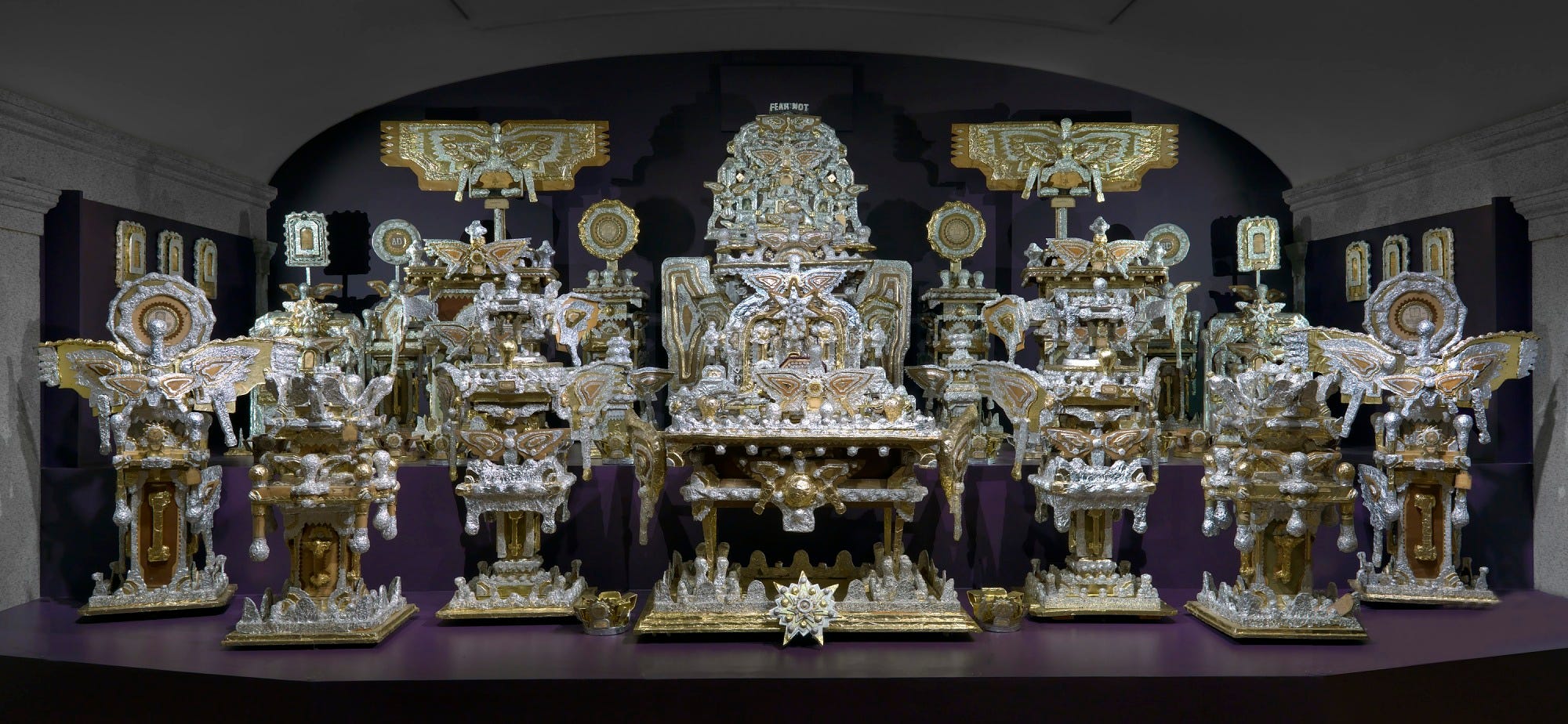
In 1931, James Hampton started receiving visions from God. While working the night shift as a janitor in a federal building in the capital of the most powerful nation on earth, he was commanded to build a throne, the seat of God’s terrestrial authority, ahead of Christ’s imminent return. Hampton rented a carriage house in 1950 and, over fourteen years, dutifully set himself to this task. He collected material while at work and scavenged broadly elsewhere; foil, plastic, cardboard, jelly jars.
Hampton’s resulting masterpiece, The Throne of the Third Heaven of the Nations’ Millennium General Assembly, has an alien aspect that distinguishes it from typical religious art. Covered in silver and gold foil, the shapes allude to familiar designs (baptismal fonts, altars, tabernacles) without fully conforming to them. I get the impression, looking at it, that it references a truer, protean version of these things, that it gets closer to the essence of them than anything in the Vatican, as if here were the crude materials of worship itself. Matter from another world. The rough shape of ideas. The Third Heaven: God’s realm.
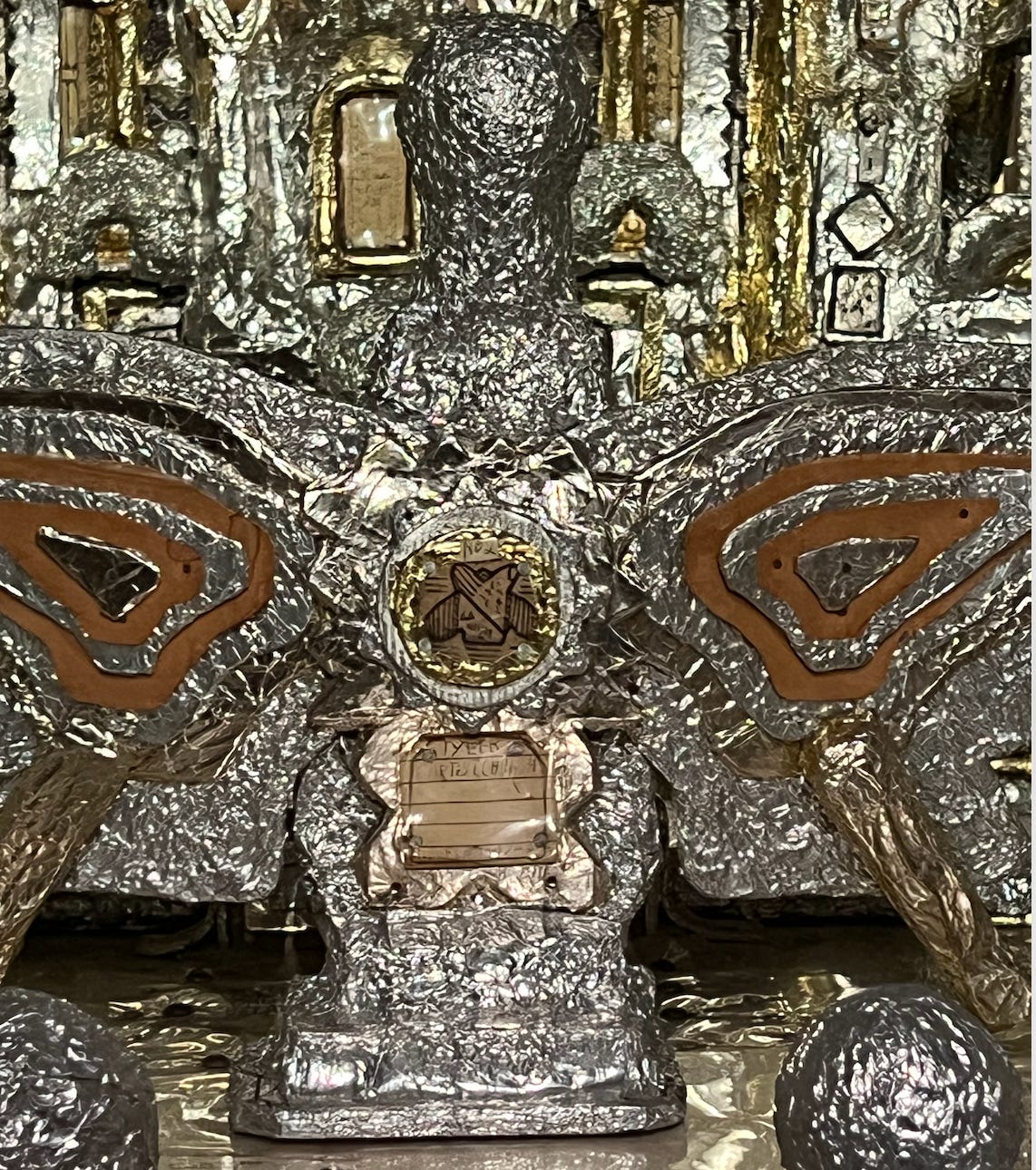
Beneath the foil is old furniture, burnt-out lightbulbs, and general refuse. I imagine Hampton seeing an object in a waste bin, and immediately recognizing its place in the grand design. There are 180 pieces in The Throne of the Third Heaven. Its layout is symmetrical. On one side is the New Testament. On the other, Moses. The grand forms are annotated with an invented, undeciphered script. Hampton, like Hildegard of Bingen, received the language from above. The latter said she didn’t invent a language, but unearthed it. I imagine Hampton would have felt similarly.
Floating above the throne itself are two words, written in English. Hampton was unwilling here to risk illegibility: “FEAR NOT.”
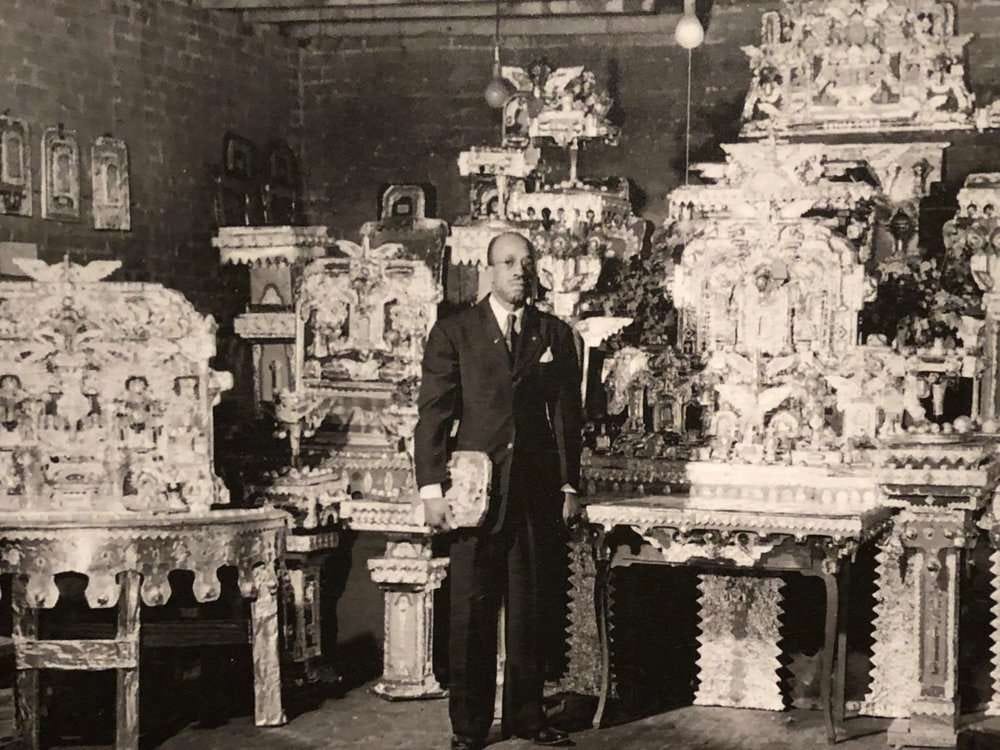
A Black man laboring in the heart of empire, whose thankless toils contributed to its maintenance—the word “Inside” feels more accurate of Hampton than the “Outside” frequently applied to him. The term “Outsider Art” makes some people uncomfortable. This is because, I think, it calls consent into question.
Classical art involves mastery. Control. Education. Execution. We’re assured of the artist’s agency. What makes people slightly nauseous about Outsider Art is that the works are often products of pure compulsion. Madness. Obsession. Delusion. Outsider artists are defined by their lack of classical training. They are self-taught. They rely on intuition and an urgent feeling of necessity that’s indistinguishable from a manic episode. This makes us voyeurs. Perverts.
Yet inspired art incorporates many of the same elements that distress us about Outsider Art. The enduring fascination with Francisco Goya’s Black Paintings; the prospect of a naughty peek into madness. The forensic fascination with Van Gogh’s later works; a window into the asylum. The gospel of Frida Kahlo’s pain that’s become the necessary lens for her body of work. Illness compels us. The narrative of genius is often accompanied by details of affliction. The unspoken argument beneath is that affliction, pain, and madness work through these artists to achieve their superhuman results. It’s the Christ story, in a way. Mere matter, anointed with suffering, made divine.
The relationship between suffering and genius predates Catholicism. Plato’s Phaedrus argues that there’s a dispossession, a drunkenness in art. In it, Socrates argues that theia mania, divine madness, the sublime unsettling, is the essence of genius. To work strictly within sober conventions is to preclude genius. Plato, whose utopia would have exiled poets, writes that the poet who approaches poetry relying on technē (competence, skill) alone will find themselves eclipsed by those willing to surrender their sanity to the Muse.
Unwellness gives Outsider Art its authority, as well as its air of blasphemy. Affliction, and therefore death, infiltrate and overpower intent. Today, we like to imagine the human heritage of art as life-affirming, preferring to believe that art transcends mere necessity. Artistic agency is crucial to that end. We come to the art museum hoping for temporary amnesia of our mereness; an escape from the banal fact of ourselves as small beings, a freezing of history as its vicissitudes crash against the stone walls outside. We’re, in other words, afraid.
Inspiration has always been a frightening prospect to me. The word literally means to be breathed into, to be filled with a foreign breath. The breath of what? God. The Muse. Something else entirely, lurking in the abysses of the unconscious. Regardless of the What, inspiration instills an intolerable sense of distance between the glorious form in our heads and its absence in the material world. Toil is the only remedy.
Hampton’s work was kept a secret. This is another common hallmark of Outsider Art. What marks them as “outsiders” is the refusal to cooperate with the pride and greed of “the art world.” Hampton didn’t live to see how his project would be received. I wonder if he would have cared either way. His purpose was pure. This isn’t to say it was innocent. Pure purpose is madness. Purity of any kind is intolerant to us. Either we besmirch it with our meddling, or it dissolves us.
Human beings have been toiling in the hulking shadow of empire since the dawn of empire itself. We all participate in the general economy of energy as it moves across the surface of the earth. Wealth, as Georges Bataille argues, is a surplus of that energy. Surplus guarantees waste. Art is, strictly speaking, wasteful. It shares this with trash. Hampton wasn’t wealthy as we would define wealth, but his Millennium Throne is a byproduct of wealth, only possible in an empire with surplus. His work, then, is a product of Empire.
Wasn’t Christ a product of Empire? I prefer the interpretation of Jesus that translates tekton not as carpenter, but as builder. I like the idea that Jesus got his hands dirty with Empire, that his sweat was mixed into the wet concrete of Empire, that Empire bore the tender fruit of its own destruction on one of its many neglected boughs, that the messiah who would set Rome on fire with his message had his fingerprints somewhere on an aqueduct, or a road, or a federal building, along with those of countless other laborers.
Seatbelts, please. We will be landing shortly.
Hampton’s materials were the detritus of a colossal entity that would have manifested to him, as it does to me, as a system of pressures and aesthetics; its true nature, something of a mystery, but felt. Empire is not unlike God in this way. Those who live in Empire, those who live in History, live in non-consent. We’re subject to material circumstances. Inspiration, divine breath, presents the opportunity to answer to a different authority, one not of this earth. Sacred submission.
My belief is that Hampton achieved his goal in The Throne of the Third Heaven of the Nations’ Millennium General Assembly. I believe Christ sits on it. Insofar as I accept the notion of Christ, this is the one I prefer: the Redeemer. The Savior. The son of a God that rescued a broken and discarded object from the bottom of a waste bin and gave it a divine purpose, who chose as his messenger not a king, but a worker.
In Hampton’s materials, I come very close to seeing the shape of Empire, the way an entire ecosystem is implied in an owl pellet. In its ambition, I come very close to seeing God. The shape of inspiration; the otherwise invisible breath. Mereness and matter. Madness and the miracle. They conference here. They reach a univocal decision. They have good news to share.
FEAR NOT.
Good golly, you clearly had that ‘breath’ in you for this piece !