
In Captivity
On the wild, the tame, and the boundary between

For Grayson, silver and fierce. Rest in peace, big man. Minnesota has a special place in my heart. You can support Minnesotans defending their communities from ICE here.
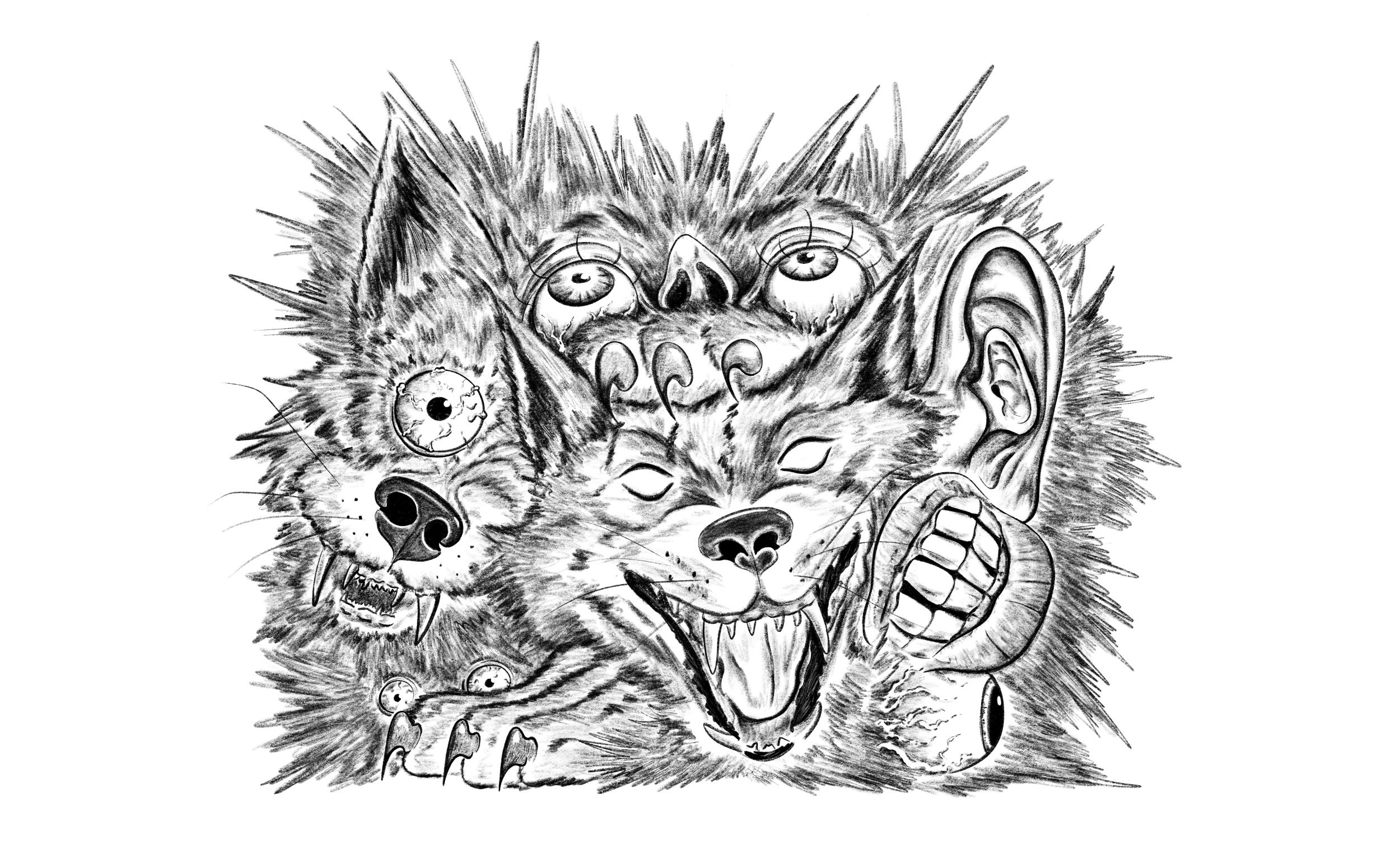
Rieka, the she-wolf of the pack, has yet to choose her mate. For over a year, she’s been flirting with Grayson, an Arctic gray wolf five years her senior, as well as with Caz, who is one year younger than her. The third male of the group, Blackstone, is not under Rieka’s consideration whatsoever, for reasons the wildlife expert didn’t elaborate upon. I believe this was out of politeness to Blackstone.
“I thought she would’ve made up her mind by now,” Chris whispered in my ear during the presentation. Rieka had been dating around when he’d last visited her several months ago. “She doesn’t want to choose between her serious older man and her boy toy. What a queen.”
Chris, Eric (his mate), and I were seated in a small carpeted amphitheater in the International Wolf Center in Ely, Minnesota. There’s little coherence among the types who visit a wolf center on a weekday afternoon. The audience was a human variety pack: a mom and her little girl; a skinny teen boy dressed in head-to-toe camo; an elderly couple whose mutual hatred was palpable; a Scandi family of five with blindingly white hair, from dad to mom to children; three homosexuals.
A woman in a green uniform stood front and center delivering a presentation on the four wolves that inhabited the leafy enclosure behind her, though not one of these much anticipated celebrities was visible through the tall panels of glass separating us from their accommodations. The absence of the wolves lent the woman the obligatory air of an opening act for a boy band.
“I’m sure you’ve all heard the term ‘alpha,’ but we’re moving folks away from that language,” she explained with the practiced enthusiasm of wildlife experts everywhere after catching us up to speed on Rieka’s love life. “Nowadays, we’re more likely to say ‘breeding pair’ to describe the two wolves in the pack responsible for having pups.”
I thought this shift was perhaps a clumsy application of human-to-wolf feminism. It was closer to the opposite, an attempt to put distance between two species. The term “alpha” and its attendant baggage has, we were told, distorted our perception of wolf dynamics, which have long been the subject of human projection. The wildlife expert delivered this portion with the pronounced exhaustion of a person made aware of Teen Wolf entirely against her will.
It was a gray afternoon, the second day of our Ely trip. Ely is a small town about a four-hour drive from Minneapolis, where Chris lives. We’d attempted fishing that morning and failed spectacularly. Our sissy pack had been uniformly squeamish about setting the fat, writhing nightcrawlers we’d purchased at the bait shop on our hooks, and we’d struggled to cast our rented rods. It was chilly out, despite it being August, and drizzling. My line had snapped during a heroic struggle against what revealed itself to be a log.
The crappies of Ely having won the day, and unsure what else to do, we tucked our tails between our legs and headed to the International Wolf Center, which, I was repeatedly assured, provided an overall more satisfying experience than the nearby International Bear Center.
“We might even make it for wolf enrichment hour,” Chris beamed as we piled fishlessly into his car. “Eric, call them up and ask them when it is.”
We made it right on time. Every day, the ambassador wolves have a scheduled “enrichment,” in which they’re presented with a sensory experience to challenge the monotony of their lives in captivity. This can take many forms, the most evocative of which, per our presenter, was undoubtedly “meat-scented bubbles from a bubble machine.” Sometimes, it’s auditory: a recording of another pack’s howls is played, or music. I wondered whose job it was to dream up increasingly inventive ways to stimulate wolves, and if I’d be any good at it.
These enrichment exercises are of the utmost importance. Wolves are, we learned, neophobic, afraid of new things. Given the opportunity, they’ll establish a routine, then utterly capitulate to it. Allowing them this would be bad for them. Living in nature regularly presents quandaries for a wild thing to solve, the earthy equivalent to daily crossword puzzles. In human custody, however, their instincts will dull, their brains will atrophy, and they’ll become too stupid to live. So it’s important that they’re frequently stimulated, that they’re “enriched.”
“And today is their favorite kind of day,” the expert went on after demonstrating that a determined deer hoof could quite easily puncture a hole in a wolf’s skull, “it’s a food-based enrichment!” The day’s item: chicken foot popsicles.
On cue, three humans wearing ponchos and hauling buckets entered the enclosure in a scene evoking Jurassic Park. I pictured them being set upon and brutally devoured before our eyes, blood and guts splashing up against the windows. But, we were told, these were professionals who’d been properly socialized with the pack. We were advised not to attempt anything we saw them do ourselves. I found it difficult to imagine the circumstances under which such an opportunity might present itself, but one can never be too cautious.
“Mommy, look!” the little girl said, pointing toward the back of the enclosure. The wolves had crept out of a cave and were lumbering down toward the handlers. This surprised me. I figured we wouldn’t be seeing the wolves at all. It was such a sleepy, dull afternoon, and we’d already been curved by nature once that day. On top of that, I personally felt that if I were a creature in a terrarium with dedicated audience seating, I wouldn’t bother to show up, would withhold the spectacle of myself, out of contempt. But here they were, the beasts from the European folktales, trotting right up to the glass.
The ambassador wolves, a title that conjured wolves with lanyards and packed itineraries, sniffed about the humans with mute curiosity, behaving remarkably like any dog one has ever interacted with. The professionals meted out hunks of ice, tossing one into the pond with a plop and another into the grass, then left the pack to do their homework. The presenter told us who was who, though I’d surmised their identities based on prior information: Rieka was regal and elegant. Grayson was silver and fearsome. Caz was svelte and athletic. Blackstone.
As far as I could tell, the concept presented by the chicken foot popsicles was “delayed gratification,” an idea that did not impress Rieka, who quickly lost interest, and that seemed to genuinely offend Caz, who was beside himself at the fact that the desired chicken foot was visible, but not immediately attainable. He scooted the block of ice around with his nose, pawed at it, looked at Rieka as if to say, But why? Surely, they wouldn’t? I wondered, with some sadness, what life must be like for a wolf in captivity, reliant on a god race of bipeds that distributed meals and riddles every day.
But then, didn’t my life look an awful lot like that?
If I were to go against the wolf expert community’s wishes and make a direct comparison, I’d argue I was the one with the raw deal. I paid rent on my enclosure, and my morning puzzles were packaged with a monthly newspaper subscription that I was pretty sure crept up in price without my noticing. These puzzles, according to every available metric, weren’t doing a great job at enriching me. My brain was turning to mush.
That was the big reason I’d taken this trip in the first place. I was becoming too stupid to live.
Ely, Minnesota, is the gateway to the Boundary Waters, a series of lakes, bogs, and some million acres of land along the Canadian border. Chris spoke of them with starry-eyed reverence. Free of roads, buildings, and human interference, it’s a true wilderness. The “boundary” references a line between countries, but the name evoked a different kind of threshold to me: a tangible buffer between civilization and nature, between the wild and the tame. It lent Ely a certain Lovecraftian mystique; an outpost on the edge of oblivion.
That’s how one mentally-ill romantic saw it, anyway. Practically speaking, Ely is one of those small, charming towns accustomed to tourists, dancing between rugged authenticity and parodic awareness of itself, choreography required of any town with ambitions of selling sweatshirts emblazoned with trout and quips about nagging wives. There’s a restaurant with an industrial theme called Insula that caters to out-of-towners where we ate three times, as well as bars with names like the Frisky Otter and the Kwazy Wabbit. The three of us stayed in a small house (the decor of which I’d describe as “maybe we fish, maybe we don’t”) within walking distance of the coffee shop, accessibility to cold brew having been my only real requirement.
I’d come to see Chris, my close friend of many years, a six-foot-something, heavily tattooed, consummate Midwesterner of Scandinavian descent who’d say “bahg” out loud whensoever I asked. More importantly, he was an incredibly rare person with whom I could socialize with ease. Over time, we’d cobbled together a private language of low-quality song lyrics, niche pop culture references, and callbacks I could deploy when I couldn’t think of anything else to say.
This induced much suffering in poor Eric. But I had my needs, chief of which was the need to be social without any of the typical effort involved before my reclusiveness turned me into a macabre news story. I thought, too, that maybe some time in nature would fix me. I considered any place with a sufficient number of trees to be “nature.”
It had been an exceptionally difficult summer. I’d forgotten how to be a person. Communication had become enormously challenging. People would speak to me, and I would trip over my words, say things like “Did you grow up Catholic?” in response to “How’s it going?”
My daily rituals were as miserable as they were unchangeable. I’d wake up, check my phone: notifications from dating apps, spam texts, Fidelis informing me that my “health risk assessment” was “waiting,” and then scroll social media, where I was invited to weigh in on whether or not restaurants were a form of slavery, and to help determine if interracial dating was immoral for conservative reasons, or progressive ones.
Past that, I’d get my coffee, do my puzzles, sit around, wait, get my second coffee, work out, eat, wait some more, and, at some blessed point, find sleep so I could wake up and do it all again on the other side of my wacky, melatonin-induced nightmares, dreams that commonly saw me moving back to Oklahoma to complete a math course I’d skipped as a teen (my argument that I was an adult with a published book went ignored).
My hair was growing out into a frizzy tumbleweed. I made no effort to comb it. My meals were increasingly losing definition, and could most accurately be described as “meat slop.” I would pace around my apartment, unsure what to do with myself. I was struggling with tasks that come naturally to newborns, such as sleeping, breathing, and urinating. I’d become hyper-fixated on these automatic processes. Was I breathing deeply enough? Did I need to pee? Was I sure? I’d frequently get out of bed, walk to the bathroom, lower my briefs, and stand there with my dick hanging over the toilet, waiting, arguing with the unseen systems inside me.
My brain lost trust in the warm-blooded stranger of my body, a civil war that disrupted every aspect of my life. I didn’t have time for much else. My email inbox was cluttered with unanswered queries. My bedroom was a mess. I canceled drinks. I skipped events. I missed deadlines.
I considered crying out for help, but I didn’t know how. I couldn’t articulate what was wrong even to myself, much less to someone else. And who would that “someone” be? Perhaps an odd question for someone with a psychiatrist to ask. But, frustratingly, I’d become more lucid when speaking to her. I didn’t have it in me to tell her, “I’m going crazy.” I considered this an uncouth, dramatic thing to say. This inhibition only manifested, apparently, when speaking to a mental health professional, and was not present at house parties, where I believed “Would you say I look normal to you right now?” was an altogether appropriate way to introduce myself to strangers.
I found myself wishing my situation was more obviously alarming. Technically, I was getting along. I was functioning. That was the worst part, in my opinion.
I was on several medications, including Prozac, and a vintage drug called Tiagabine, an anticonvulsant specifically prescribed to abate what I was told was “sensorimotor OCD,” a preoccupation with bodily functions.
There have been other diagnoses, conditions and labels I’ve increasingly lost faith in over time. Psychiatry is far from a perfect science. All I know for sure is that, in any society but this one, I would have been put down, or locked in an asylum, or, if I lucked out, relegated to some ceremonial role that didn’t have me interacting with anyone else, one with a hut, a cauldron, and an elaborate hat involved.
I considered what it might look like to declare myself unfit to carry on, to say what I assumed were those dire magic words, the escape hatch: I am presently a danger to myself. I was tempted, but then I’d imagine where this would land me. A blank room, green Jell-O, beige grippy socks. Would they confiscate my phone? What if my roommates were annoying? What if I was unpopular? Not worth the risk. And anyway, it felt dishonest. I wasn’t likely to hurt myself. I was fully capable, I was pretty sure, of lumbering on like this indefinitely, until cancerous boredom finally claimed me in some slow and uncinematic fashion.
It became evident there was no way to opt out of “everything,” no way to raise my hand and say, “I quit!” Because, quit what? Society itself? I didn’t have a job. Not a real one, anyway. I worked from project to project, contract to contract. I didn’t have an office. I could pretty much go wherever I wanted to go. It was just that I didn’t, opting instead to stick to my familiar few blocks in Brooklyn. I had plenty of friends and activities to engage with, if I so chose. There wasn’t any specific thing I could point to as being wrong, and I had all the remedies in the world available to me if there was. I hoped there was; hoped there was some single, namable, fixable thing wrong with me.
The alternative truly frightened me.
I didn’t realize how far gone I was until a friend dragged me to Animal, a gay bar that had recently opened up in my neighborhood that I’d been to a few times. I’d long struggled with anxiety, but could always more or less get around. I rarely met people’s eyes, but I could talk, could even be charming. I’d lost these powers at some point over the past few months. I found myself standing silently among the crowd in the dim, gay-bar dark, eyes darting frantically around, unable to focus on any one thing, a total social nonparticipant.
“Are you okay?” my friend asked me, to which I responded, “Hmm? Oh! Love to look at things.”
I booked my flight to Minnesota on my phone right then.
Shortly after landing, I figured I’d made the right decision. Talk came quickly and easily with Chris. I also got to meet Eric, his boyfriend of over a year who I’d heard all about, and who was more than patient with the both of us as we noxiously played “remember that time when?” in front of him. I’m not sure if either of them picked up on the state of my mental wellness, but, to me, the whole project had the vibe of letting a fragile, wounded deer wobble out of a crate and back into the forest.
After picking me up from the airport and letting me ride shotgun (I get violently carsick. I am a patchwork of frailties in the shape of a heavyset man), Chris drove us to Duluth for lunch. Over sandwiches, he informed us that, sadly, due to climate change, a species of worm specialized to feed unobtrusively on deer brains had recently made the leap to moose in the north. Unlike the deer, who could carry on just fine without even noticing that its brain had become a buffet, the compromised moose would walk around in confused circles until it died.
“We are the deer, Eric is the moose, and I brought the worm,” I said. Eric emphatically agreed. We continued on to Ely, where we had dinner at Insula. I ordered a “chicken tikka bowl,” which was quite good, even though that is not what it was. We attempted to fish. We went to the International Wolf Center.
We were, all of us, mesmerized by the wolves. I wondered why. Frankly, they weren’t so exceptional. They weren’t exactly huge. I’d seen bigger dogs idling in the Brooklyn coffee shop where I regularly sit to stare at my precious blank Google documents. They shared a good many traits with huskies. Certainly, there were some visual characteristics that distinguished them: their paws were bigger, their snouts narrower.
But I figure it wasn’t so much about what they looked like. There was something else about them that made us sit and stare at them for so long. It was the thing that had brought all of us to the International Wolf Center in the first place. It was the sheer fact of their wolfness, their wildness, an attribute that rendered them remote no matter how close they physically got to the windows that separated us.
Were they wild?
They lived in an enclosure behind glass and were totally dependent on the humans that cared for them. Did this not put them roughly on par with domesticated dogs or nonverbal toddlers? “In captivity” is how we describe nonhuman beings that should be living in nature, but aren’t. Animals in zoos, for example. But how do we determine what should be living in nature, and what shouldn’t? If an animal living totally dependent on human care is a captive, what does that make us?
I thought Caz had given up on his assignment. He’d pushed the wretched chicken-foot popsicle into the pond, completely out of his sight. But after some time, he noticed that the ice around Blackstone’s chicken foot was melting. Typical jock, I thought as he sauntered up to Blackstone right by the window, copying the nerd’s homework. This new interaction between the wolves brought all of us in the audience into a polite yet competitive huddle near where they stood.
This held our collective interest for a few minutes, but after a while it became apparent that it wasn’t uncommon for the wolves to be mere inches from our faces. Accessibility deflated the intrigue. Most elected to wander about the rest of the center, reading wolf facts and sampling wolf howls and returning intermittently for more sips of wolf face time, despite already having their fill.
I did this for a while, too, until I had one of those moments when life arranges itself into a painting, when an image presents itself and commands attention. I was transfixed. I told myself, don’t look away, don’t make any sudden moves. I wanted to savor the sight before it scurried away, this rare thing I’d long suspected was eyeing me from the dark, visible now, if only for a moment.
The little girl in the pink coat was sitting right next to where Caz was pushing the chicken foot popsicle about with his nose; a thin, transparent membrane between them.
"Rieka was regal and elegant. Grayson was silver and fearsome. Caz was svelte and athletic. Blackstone."
I am not normally someone who laughs out loud while reading but this got me so good I genuinely had to stop reading for several seconds to regain my composure. Brilliant work as always
"I found myself wishing my situation was more obviously alarming. Technically, I was getting along. I was functioning. That was the worst part, in my opinion." Relatable!