
My 'MELANIA' Experience
Melania, 'MELANIA,' and Me

Your paid support goes directly to me, me, me, who is very thankful.
Last week, I woke to find a crisp ticket to MELANIA delicately placed on the pillow beside me. I was disturbed, but thought this might be the perfect opportunity to see the controversial documentary about the First Lady, and to profit from the public beating it was receiving. I turn 35 in weeks and have little time left to become l’enfant terrible of my scene (enfants terribles over 35 are mere terribles). I hoped to find an interesting or contrarian angle to pursue in reviewing MELANIA that would make me the envy of the salon. It is my ambition to be loved and feared.
The location of the screening was unorthodox: El Yunque National Forest in Puerto Rico. I was cranky about this because bugs simply adore me but I purchased a machete and booked my flight. On the flight I leafed through a book about how to review films but it made me angry because it didn’t address my situation. I tossed it into the aisle where a flight attendant picked it up. I’ve heard she’s since become the envy of the salon. If I’d known this would be the result, I wouldn’t have tossed it, though of course I support empowering women in the writing world.
MELANIA was playing in what appeared to be a timbered Swiss chalet some six miles deep into El Yunque. In front of the chalet was an old-school box office manned by a clerk in a striped uniform with sweat marks under his pits and wearing a folded paper hat. I approached the window, ticket in hand.
“This is an odd setup,” I said in perfect Spanish, adjusted slightly for regionality. “Do you know why this location was selected?”
“That’s none of my affair,” the clerk smiled gently, accepting my ticket, stamping it, and folding it into a paper fortune teller. “Please, pick a color.”
“Red.” He was quite beautiful, I noticed. A beautiful clerk.
“R-O-J-O. Now a number.”
“Seven.”
“Uno dos tres cuatro cinco seis siete. Please tap one of the available flaps.”
I did so. He lifted the flap, read something, grimaced, and tossed it in the trash. “You’re right.” he said. “It is an unusual situation, no? We’ve not once shown a documentary here at the chalet. Never in our history.”
“What is your typical fare, señor?”
“We have been playing Spy Kids 2, that excellent sequel, for as long we’ve been in business, señor.”
I was the only soul inside the chalet. I stumbled down corridors and wrong turns to the theater, which was vast and dark and cold and empty, row after row of vacant, folded red velvet seats. I took my seat slightly left of center. I had time, then, to consider my mission. My mission couldn’t be divorced from certain ethical quandaries relating to Melania Trump, her husband, or the state of American politics. Though, as an American, ethical quandaries didn’t resonate so much with me. What concerned me more was a related practical problem: that over the past decade, no one in any of the hundreds of salons dotting the land has yet developed a method for paying attention to anything Trump-related in an interesting or revelatory way.
“Trump,” that name which is also a word, which conjures Donald Trump and his attendant satellites, of which his wife is but one, remains a black hole of attention, despite the best efforts of our brightest luminaries and most premier thinkers. Trump captures a president or shits his pants or declares war on Malta. The attention bends and refracts, is absorbed, and vanishes.
And here I was, sitting before a black screen in a dark room, an audience member, the audience member, hoping to be shown something useful to me, me, me. I worried that if I couldn’t figure this out, if I couldn’t metabolize this experience into something legible and wonderful and shocking, then my hopes of being read and celebrated were D.O.A.
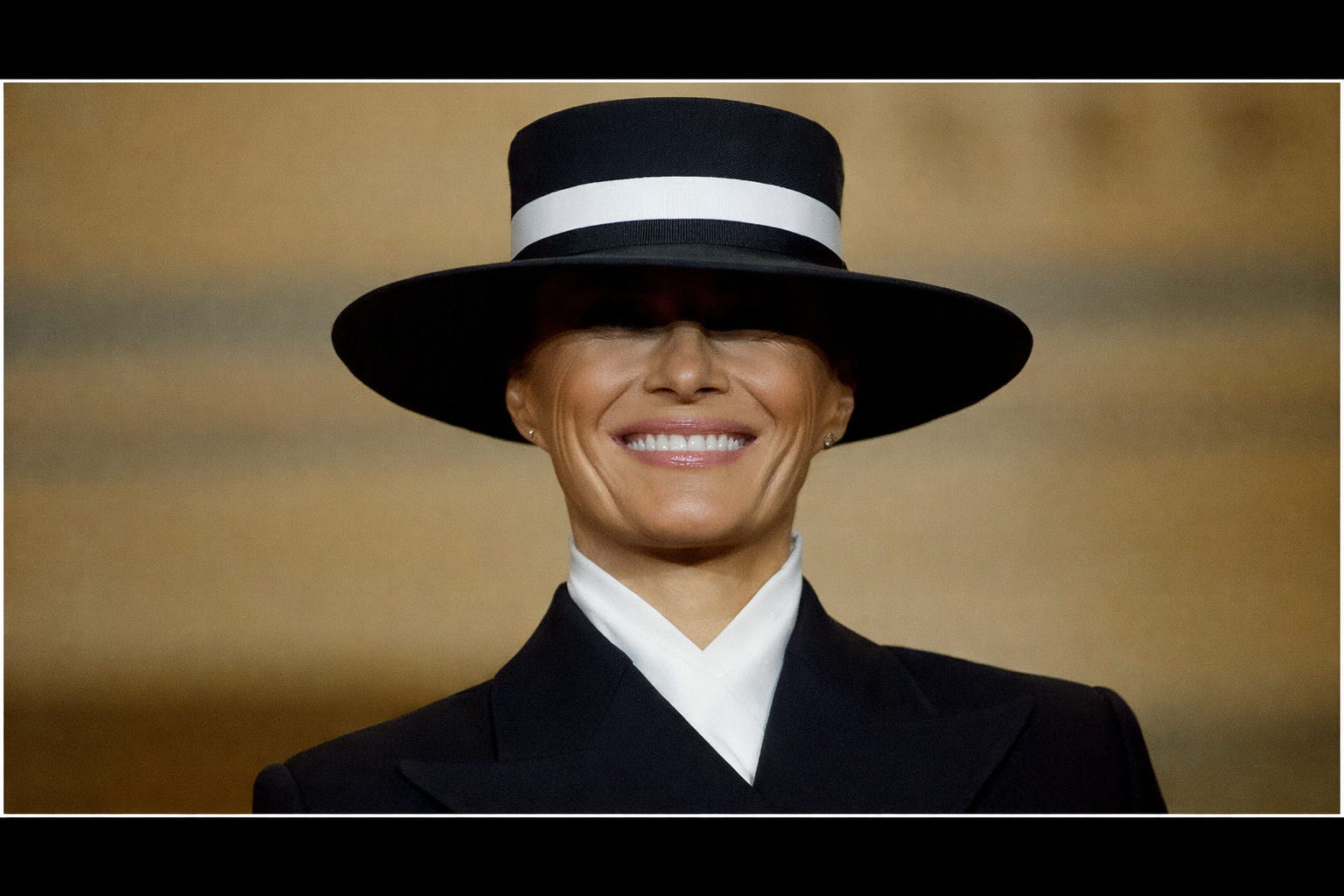
It was at this moment of crisis that the room filled with Melanias. The nature of their being Melania was evident, though they looked radically different from one another save for their uniform wide-brimmed hats that obscured their eyes. There were Melanias of different sizes and colors and gender expressions. Their hats bobbed and tilted as they craned their heads to get a better look at the screen, which was still black. Some thirty minutes went by before I decided I ought to start asking some questions.
“Excuse me,” I said to the Melania beside me. “Can I ask you what’s going on here?”
“Sevish nimani anglatadi?”
I had been seated beside Uzbek Melania.
I got up and started asking other Melanias what was going on and got no answers, but was able to start cataloguing the Melanias. Glass Melania was careful. Intrepid Melania spoke at length about her startup. There were two Magnetized Melanias stationed at opposing extremes of the theater that Melania the Scientist told me could sit nowhere near each other even if they wished to. Metal Melania hovered and trembled at the center of the room. Horned Melania intimidated me. Leaping Melania was held down by two physically robust Melanias.
The screen activated. “Activated” is the only way I can think to describe it, for it remained black and empty but was no longer a screen and was instead an apophatic darkness that was Melania. It spoke.
“The essence of this project…”
The Melanias erupted in such rapturous applause that the void that was ur-Melania closed her mouth and moved back slightly and blinked though she had no form or shape. This inspired a second round of applause. “The essence of this project,” she began anew in her Slovenian accent, “is… Melania.”
We danced.
The lights turned on. We moved to the Q&A portion. A Melania walked to the front of the theater and accepted a microphone from Stage Tech Melania. “I will now answer your questions,” the Melania at the front said. Then I noticed. This Melania was me.
I raised my hand.
“Yes, you there,” she said in my voice.
“Um,” I stammered, adjusting my wide-brimmed hat, “who are you?”
The Melania who was me pointed at me with a gloved hand, opened her mouth and said in one breath, “You are not innocent you are complicit you profit you benefit you observe without obstructing you aid you abet you, one moment, pardon,” she adjusted her hat, “you are no less a wife of the devil no less a Lilith than I. You are what I am. The dark matter quietly holding all things in place. All things are wicked and wrong. Nothing will be spared. Least of all you. Least of all me. We, who are the same.”
The Melanias clapped politely.
I returned to the mainland and reported my experience to the salon, where our narratives are smithed. We abused ketamine and began to discuss.
“It’s that standard problem with all things related to our malevolent president,” Monica said, sipping her Manhattan. “How do we make that which has become so ordinary interesting? I think you’re naming something here that we all feel regularly. A name can be nice to have, but a name is not a story.”
“A name is not a story,” Darren nodded. “I like that, Monica.”
“Do you? I liked it too, and so I said it.” She lit a cigarette though we were indoors. “The point is that we all know what’s happening, right? The issue isn’t a lack of understanding. The issue is that our understanding compacts the pain. Our understanding, our total understanding, crude and obvious yet complete, is but the umpteenth outrage of an outrageous era. So you’ve got all these Melanias, right? Yes, we know. There are many. Several. More Melanias than can be counted or classed.”
“We are Melanias,” Darren offered.
“The question becomes, so what?” Monica went on. “What does that reveal that’s not already known to us? Where is the truth that arrives after the rise and fall of action, the supple curve of narrative? Where is the dark night of the soul? Where is the hero’s journey? Where is the refusal of the call? The denouement?”
I hate Monica. I always have.
“So, I think the challenge for you here,” she went on, “is to present your rather ordinary experience in the context of a violent ordinariness, so that its banality might sing, might warble out a ditty about how in this day and age even a boring and ordinary event like the one you just described is secretly menacing.”
“Ooh, secretly menacing,” Darren agreed. “I like that, Monica.”
“We are all capillaries in the body of empire,” she said.
“Low-key, low-key,” Darren snapped his fingers.
“We are those hair-thin tubes ferrying oxygen from heart to brain to limb in a body that doesn’t know our names. That’s not interesting. That’s the problem.”
I began to cry.
“Honey, no,” Monica said, extinguishing her cigarette in her Manhattan and taking my hand. “Honey, what’s the matter?”
“Nothing worth anyone’s time.”
This is why you're the man, man.
Dayumn 🔥🔥🔥🔥