
On Performative Reading
Language, resentment, magic, and morals.

Your paid support makes my writing possible.
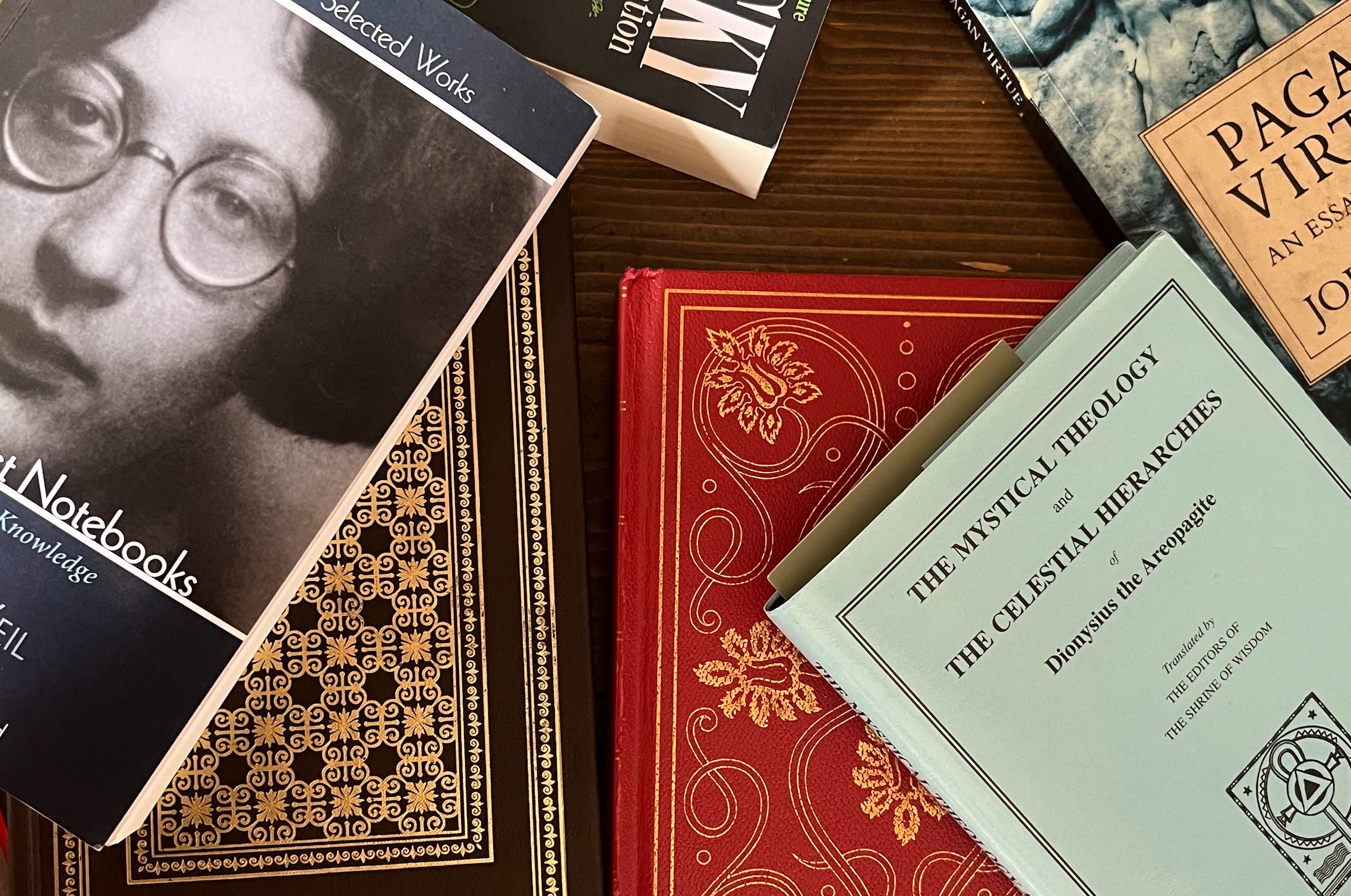
I regularly read on the subway. Physical books. Increasingly, these books are leatherbound tomes. I’m at high risk of someone sneaking a photo of me and posting it online with a caption like “Look at bro seeking occultic wisdom in the grimoire… you are not a vibe my guy.” Plus, my fit will probably be trash.
“Performative reading” is an allegation of inauthenticity. “You’re only reading to be seen reading.” It’s of a kind with “performative outrage” and “performative allyship.” The word “performative” can be appended to any public expression of morality. In the constant jockeying for social capital online, it’s a useful tool to address a phenomenon we all know takes place, but is uncomfortable to state plainly. People are lying. They are not who they say they are. They are pretending to be good people for personal profit.
It should go without saying that no one should let themselves be bullied out of reading Infinite Jest because of rude posts on the internet. Ignore. But it does seem to me that reading books, and professing to reading books, invites a certain resentment these days. Resentment usually has something interesting to say. There are things in every culture that typically go unsaid, but find expression in resentment.
Resentment is the mind seeking revenge for the experience of jealousy. “You think you’re better than me.” It’s the inevitable outcome of classed society. Any time it presents itself, it’s an occasion to consider how our particular civic project is chugging along.
When we talk about our literacy crisis or “performative reading,” it feels obvious that we’re not, or shouldn’t be, talking about book sales, but about virtues and ethics. About the kind of society we want to live in. It was a mistake, and itself a byproduct of internet polarization, to cede the very concept of morality to fundamentalists. To speak of principles and standards of behavior makes me feel like some kind of neopagan pervert. This is a problem. “Morality” shouldn’t be the sole province of the worst examples of online moralists.
The world I want: Ideally, engaging seriously with literature would be a mundane activity, not an exotic hobby that warrants creep shots. I would like to move toward that world. To that end, we have to create a culture in which reading is not a moral statement at all.
Reading wasn’t always thought of as a moral act. Plato warned that the written word could degrade the soul, because books are passive and can’t argue back. Historically, there have been moral panics around the addictiveness of novels that don’t look so dissimilar from contemporary concerns about TV and streaming. Both cases, however, speak to the enduring power of the written word, and to the relationship between literacy and the character of a specific society in time. This is true for us as well.
Our present emergency is decidedly language-based. Social media. LLMs. These are language-based enterprises. What lends books their modern moral valence is that literature stands in opposition to the Goliath of our age. As low-effort distractions monopolize our attention, literature challenges us in the right way. Where social media makes us incurious, reactionary, and cynical, literature requires nuance, patience, and critical thinking.
This is why I’m not a pessimist. I think this is an incredibly exciting time to be a reader or a writer. We who work with language are being asked to contemplate, and to take seriously, the power of language. We can make genuine contributions. Despite its attendant perils, technology has undeniably opened many doors for writers to discover each other. With the advent of generative AI, you can today be valorized simply for writing your own words. As a lazy megalomaniac, this all comes as spectacular news. Luck of the draw!
But as with any age, we have problems to address. Ours are nothing to sneeze at. I would call the culture we live in “techno-consumerist.” Increasingly, tech platforms mediate our desires, values, and habits. There is a small, ultra-wealthy class of tech CEOs, and then there are the rest of us, whose morals are downstream of theirs; negotiated on their platforms, defined by our relationship to their products. A person’s attitude on AI, for example, tells me a great deal about their values in general.
“Performative reading,” whatever your thoughts, is another example of an occasion for online outrage. Online outrage: We resent, suspect, and fight each other. What’s particularly pernicious about social media is that, in a very literal sense, our outrage enriches the tech CEOs. Our moral crusades that take place daily on their platforms line their pockets. What we have is a pseudo-morality; viscerally felt, but illusory.
These CEOs, meanwhile, abide by a completely different set of morals than we do. There’s a reason they don’t let their own children engage with the products that make them rich. Nor do they suffer from the same short-sightedness their products inspire in us. While we are glued to the present, wealth affords them something precious indeed—a vision for the future. As consumers of their products, we enact, with our very bodies, their soteriological narrative of technology.
The world’s first trillionaire is candid in his ambition to install chips into our brains. It was altogether sensible, and in keeping with that aim, for him to purchase Twitter, a product that, per memes he’s posted, he sees as similar to a brain-chip. Correctly so, in my opinion. The concept of “The Woke Mind Virus,” however pejorative, identifies the contagion power of language, as mediated through tech, to produce patterns of thought.
The anti-intellectualism that social media tends to inspire in its users, its corrosive impact on the quality of our discourse, takes on a more sinister character in this light. We are losing the ability to mount a substantial counterargument. In the words of the mystic Simone Weil, who I will quote again later, “the oppressor’s strongest support comes from the impotent revolt of the oppressed.”
The wealthy have always kept culture on a tight leash. The elite have always valued cultural mediums for that reason. Nor is it anything new for cultural output to take on the shape of the popular medium. Dickens and the weekly serial come to mind. But what feels new is that the daily churn that takes place on tech platforms is, for many, indistinguishable from culture itself. Production, consumption, critique, all happening simultaneously, referencing each other, creating each other.
Well before Elon Musk purchased it, Twitter consumed writers, academics, journalists, artists, and creatives of all stripes and trapped them in its particular logics. They were encouraged to build an audience, and to tailor their output to the medium of the tech platform where they borrowed real estate. This placed them firmly in a techno-consumerist, highly surveilled arena where baser instincts prevailed. This has been deleterious to culture.
From Plato’s warning about the written word to today’s AI-induced psychosis, it’s clear we enter a vulnerable state when we engage with language. We become porous. We induct, often without being aware of it, the character of the language we steep ourselves in. Language. The manipulation of signs. Magic. These things aren’t so distinguishable. One could look at it this way. A decent number of the best and brightest among us who should be pushing culture forward, who have the capacity to engage seriously with literature and original thought, are under spells, unable to produce thoughts that aren’t first mediated by tech.
This lends culture an oppressive, unpleasant aspect. There’s a feeling that we’re choiceless in the matter. An illusion of freedom rises to meet this. “Children in play can bear with laughter physical pains that would overwhelm them if inflicted as punishment,” wrote Weil. This is obviously true. Irony. Detachment. Humor that becomes ever darker and more self-referential. Seeking catharsis and imitations of justice in moral crusades. These seem to me to be mere coping mechanisms for addiction, and for crude obedience.
There is resentment for anyone who thinks themselves above obedience.
To this end, it’s foolish, I believe, to think we can ameliorate the ills of our specific culture by making literature a trend. Trendy literature would certainly fatten some pockets and produce bad literature and fold easily into the general techno-consumerist project. Nor can we shame, mock, or bully people into Ulysses. I tried this on myself once.
What can be done? I’m not yet delusional enough to believe I have an answer. But I do think we have the same technology available to us that the tech CEOs do. We are, as I said, already moving toward the world they want to see. In a world in motion, this is the purpose of ethics. Show us True North. We will face that way, and we will move. We should stop using the compass we were given and find another one.
In the past, religious obligation drove literacy rates. The relationship between how a society is organized and that society’s literacy is inextricable. Literacy is only one measure, but an important one. To increase literacy, we need a community that expects it of us. In a culture defined by the pursuit of individual pleasure, this will be difficult. But a community is nothing more or less than a group of people living toward something. The exciting task before us is to determine our values, and then to live them. In living them, we’re sure to find like-minded people. In finding like-minded people, we find a common language. Common language invents culture.
A world.
Get your jokes off. When I finally find the spell I’m looking for, you won’t want to be on my bad side.
Holy shit. As a long, long time reader of yours... this might be my favorite piece of yours ever. Holy shit!!
This is refreshing to read. As someone who reads and writes, I tend to share your optimism. Whenever, in popular culture, stupidity became fashionable, intelligence roared back bigger than ever. More and more, the bar is set ever so low. If you have a general sense of history, are actually literate, and have the patience to think for yourself, you are practically a god at this point.